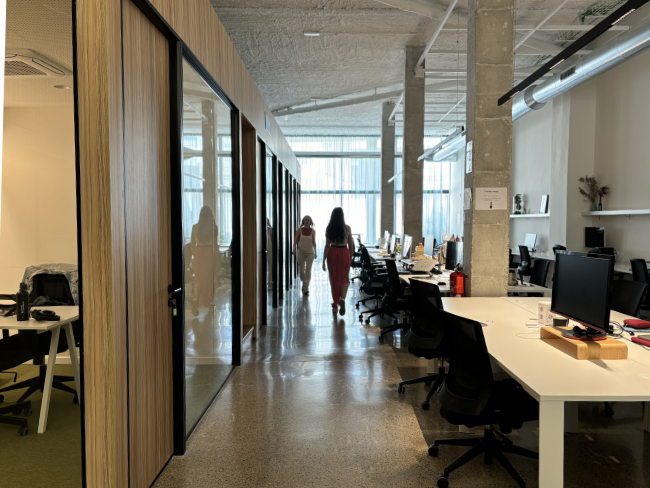

Here’s a question for you: how many desks will your team need in two years? If you hesitated, you’re in good company. Many leaders don’t know how much office space their company will need in two years. That isn’t a planning failure. It’s an honest read of the situation. In a recent Censuswide survey of 1,000 CEOs and CFOs in the US and UK, run for workspace provider IWG, 60% said AI has made it harder to predict how much office space they’ll need. Nearly three-quarters said they’re now less willing to sign long leases. And almost all of them are shifting real estate costs from fixed to variable. We get it. Nobody wants to sign a five-year lease for an office they might outgrow (or shrink out of) in eighteen months. So here’s our take, straight up: you don’t need to predict the future. You need a workspace that moves with you. A coworking space offers just the right amount of flexibility companies need during this time of uncertainty. Office leases have traditionally rewarded companies that could plan well. You estimate your headcount, sign for a number of years, and build around it. That works when the future is fairly predictable. Right now, it isn’t. iCushman & Wakefield’s research on AI and real estate makes a useful point: AI seems to widen the range of possible outcomes more than it changes the most likely one. The office is most sensitive to AI-driven change, given the concentration of high-wage, knowledge-based occupations and historically higher space intensity. Large employers may be letting leases expire and subleasing offices that have emptied out, while others are looking for smaller, flexible options. Attendance is also moving. CBRE’s 2026 occupier survey found that 89% of office-using organizations now require at least three days a week in the office, up from 78% a year earlier. Meanwhile, 23% said AI is already influencing their space planning, and another 30% expect it to within two years. When the range of outcomes gets wider, the value of being able to adjust goes up. It limits the cost of being wrong. A long lease locks in today’s best guess. If the guess is off, you pay for it for years. Shorter or adjustable commitments cap how much a wrong guess can cost. It keeps your costs in step with your business. Fixed costs stay the same when revenue dips. Variable costs move with you. That’s a big part of why finance teams are pushing in this direction. It lets space follow how people actually work. Hybrid schedules, project teams, and seasonal peaks don’t fit neatly into a fixed number of desks. Flexible arrangements let you match space to real use rather than to a headcount on paper. It speeds up decisions. Opening a new team, testing a new city, or trying a different working model is much easier when it doesn’t require a multi-year commitment first. It keeps capital free. Fit-out costs, deposits, and long commitments tie up money that might be more useful elsewhere while things are uncertain. Flexibility isn’t free, and it isn’t always the right answer. Price per desk can be higher. You’re paying, in part, for the right to change your mind. If your needs are stable and predictable, a longer commitment can cost less over time. You may have less control. Flexible space usually means less freedom to customize layout, branding, or build-out. Stability has value too. Teams that work together every day often benefit from a fixed, dedicated place. Constant change can be disruptive in its own right. The less confident you are, and the more expensive the mistake, the more flexibility is worth. The point isn’t that flexible always beats fixed. It’s that the balance between the two should reflect how uncertain your situation actually is. You don’t have to choose between “all fixed” and “all flexible.” Some ways companies can combine the two at a coworking space, like Vortex: A stable core plus a flexible layer. Commit to the space you’re confident you’ll use every day, and cover growth, peaks, and experiments with shorter-term arrangements. Shorter terms or break options. Even in traditional leases, shorter durations or break clauses add adjustability. Different formats for different needs. A private office for a team that needs one, dedicated desks for those who are in daily, and drop-in access for people who come in occasionally. Regular reviews. Revisit your space needs every few months rather than once every few years. Coworking operators, Vortex among them, offer these formats (private offices, fixed desks, and flexible plans) on monthly or short-term terms, which is one practical way to put the ideas above into action. We don’t believe in one-size-fits-all. Depending on where your team is right now, there’s a plan that fits. Your team, your space, your rules. Our private offices come with ergonomic furniture, individual climate control, high-speed internet, with cleaning and maintenance included. No fit-out headaches, no chasing a landlord. You also get extended access for those late-night calls, monthly meeting room hours, and use of our shared spaces: kitchen, lounge areas, terrace, and phone booths. And the contract is flexible too. Choose annual, 6-month, or monthly, depending on how much certainty you have. Great for: teams that want privacy and a place to call their own, without the weight of a traditional lease. A dedicated desk in our shared area, where you can leave your things (and your screen). Same spot, every day, surrounded by a community that makes the workday better. Fix members get extended access and hours in our small meeting room every month. It’s a monthly plan, so you’re never locked in. Great for: small teams, remote employees who want a real workplace, employees that only want to drop in a few days a week, and anyone who likes a routine. Our Flex Plan gives you access to our Hotdesk area on weekdays, from 8h to 18h, with monthly meeting room hours included. It’s perfect if your team is hybrid and you’d rather not pay for desks that sit empty three days a week. Great for: hybrid teams, freelancers, and companies still working out what “the office” looks like for them. For those not sure where to start, the key is flexibility. Companies can start with Flex while they’re figuring things out. Move to Fix desks as the team settles in. Step up to a private office when you’re ready. And if your team grows before a bigger office is available, you can add Flex or Fixed desks in the shared area to bridge the gap. That’s real security in uncertain times: not a promise to stay forever, but the freedom to adapt.
About the author: Pamela Muñoz, PR Consultant at Vortex Coworking.
The forecasting problem
What flexibility actually gives you
The trade-offs
Building flexibility into your office strategy
Three ways to work at Vortex
Private Office: your own door, your own culture
Fixed Plan: your desk, always waiting for you
Flex Plan: pay for what you actually use
The best part? You can move between them